

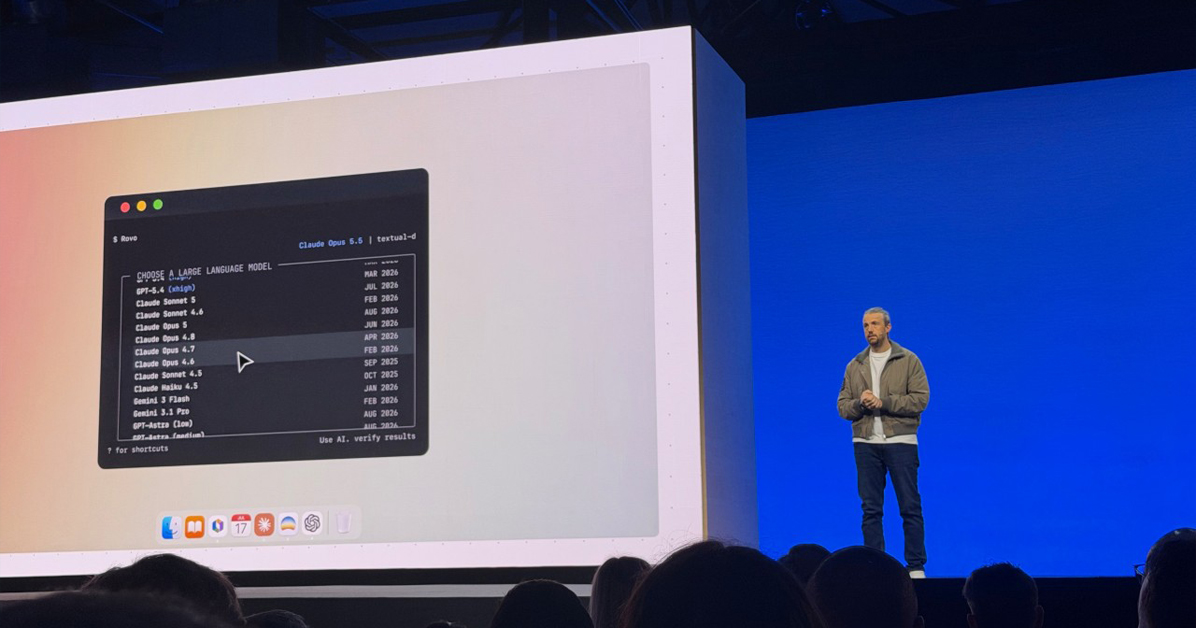
Mike Cannon-Brookes opened this morning’s keynote in Amsterdam with a story about bikes. After 17 years of visiting the city, his lesson: when a bike comes at you at 30 km/h, you don’t schedule a meeting. You react.
His point: in the AI era, a company needs a nervous system that reacts just as fast. Atlassian wants to be that nervous system.
I sat through 90 minutes of announcements. Here is what I think actually matters if you use Jira, Confluence or Rovo in your company, and what I would do about it now. I work with AI agents every day, so I looked at it through that lens: what changes for the people and teams using these tools?
1. Stop asking which model. Start asking whose context.
The line I wrote down first: “Models are the engine, context is the fuel.”
Atlassian is not betting on one model. They bet on the Teamwork Graph, which has grown to over 250 billion objects and relationships. In May at Team ’26 Anaheim it was around 150 billion.
New this time:
- Data context from sources like Databricks, Snowflake and BigQuery
- Code context down to functions and classes (Rovo Code Search, open beta)
- Agents and their sessions as part of the graph. When you close your terminal, the learnings of that session no longer disappear.
The message: bring Claude, ChatGPT, Cursor, whatever you like. They all run better on the same context.
I agree with this, and I can confirm it from my own setup. My agents are only as good as the context I give them. The model swap is the easy part.
2. AMP: agents aren’t replacing your team. They’re joining it.
The headline announcement was AMP, the Agentic Multiplayer Protocol. It has three layers:
- In-the-flow collaboration, real-time and async
- Identity and shared presence, so you always know who is a human and who is an agent
- Context and governance, with permissions that apply on and off the platform
The demos made it tangible. A Confluence plan co-written live by a person, a colleague, a Figma agent and ChatGPT, each with its own cursor and attribution. A Loom recording where you point and talk, and the result is a prompt an agent can execute.
What I like: this is the right operating model. Multiplayer, not “one human, one chatbot”.
What I’m watching: agents are getting their own accounts and non-human identities. That sounds like a detail. It isn’t. If agents are teammates, somebody in your company has to create them, decide what they can see, track what they cost, and switch them off when a project ends. Exactly like with people. Agents are users now, and your admins should plan for that before the first ten agents show up in your directory.
3. Jira stops being a plan and becomes a record
For me, this was the biggest shift of the day, and Mike said it himself: for 20 years Jira has been a picture of the work a team planned. Now it should become the system of record for the work that is actually happening.
The demo: a developer starts Claude in the terminal. The session shows up on the Jira board, live. Cloud agents too. You can see which agent is stuck, answer its question from Jira, and drag an untracked session onto the board to turn it into a work item. Fields filled in automatically.
This is exactly my daily reality. Half of my work starts with an agent, not in a ticket. Right now that work is invisible to my team. If you’re a team lead, imagine opening your board and seeing not only what was planned, but what every person and every agent is working on right now. That’s what Jira can become.
Reality check: Agent Sessions in Jira is a closed early access program, “coming soon”. The direction is clear, but it isn’t shipping yet.
4. Confidence: the topic nobody wanted to talk about two years ago
On stage, Atlassian said 77% of its own pull requests last month were completely AI-generated. More output creates a new bottleneck: review, oversight and cost.
Three answers stood out:
- Interactive PR reviews with Loom. A 54-file code change becomes a short video that shows what changed, why, and how it was tested. Product managers and designers can review without reading code. This won’t stay in software teams: anyone who has to check AI output at scale will need something like it.
- DX agent effectiveness. It scores agent sessions on clear requirements, steering, scope and model fit. One example from stage: of 3,200 documentation runs, 59% could have used a cheaper model. “Token capital” is going to be a budget line in every company.
- EU AI inference. Prompts, inference and results stay in Europe, with models from OpenAI, Anthropic and Google. This got the loudest applause in the room, If you’re in Germany or anywhere in the EU and your data protection officer has been blocking Rovo, this is the conversation to restart.
5. What I would do now as an Atlassian customer
You don’t need to wait for every feature to ship. Some things you can prepare today:
- Connect your other tools. The value comes from context. If Slack, Google Drive, Teams, Zoom or your CRM aren’t connected to the Teamwork Graph, Rovo and every other agent only see half your company.
- Clean up permissions. Agents inherit what the platform allows. Messy spaces, open projects and old users with too many rights become an AI problem, not just an admin problem.
- Decide who owns agents. Before agents get their own accounts, agree on who may create them, who approves their access, and who switches them off.
- Look at the new Atlassian MCP server. It was rebuilt with 220+ tools, up to 25% fewer tokens and more than 15 million calls a day. If your teams already use Claude, ChatGPT or Cursor, this is how they get your Jira and Confluence context, with access controlled by your admins. Better than people copy-pasting tickets into a chatbot.
- Start tracking AI cost. Not because it’s high today, but because it will be. Knowing which teams use which models is the first step.
In May I wrote that Atlassian is becoming the backend for AI and the interface for humans. After today I’d add: AMP is the interface half. It’s where people see, steer and trust what their agents do.
My honest take
Strong direction. Context first, multiplayer instead of single player, and finally a serious answer to “how do I keep oversight when everything moves faster”.
At the same time, a lot of what was shown today is beta, early access or “coming soon”. Planner, Agent Sessions in Jira, interactive PR reviews, Codex in Jira. The keynote sounds like everything is here. It isn’t yet. Judge it in six months.
My question to Atlassian admins and team leads: once agents have their own accounts in your organization, who owns them? IT, the team that created them, or nobody?
Sources:
- Atlassian founder update, Team ’26 Europe: https://www.atlassian.com/blog/company-news/team26-europe-founder-update
- AMP: https://www.atlassian.com/amp
- AI platform: https://www.atlassian.com/blog/company-news/team26-europe-ai-platform
- AI-driven software delivery: https://www.atlassian.com/blog/company-news/team26-europe-ai-sdlc
- Atlassian MCP: https://www.atlassian.com/blog/company-news/team26-europe-atlassian-mcp
